
The Instability Loop
By Sofia Harchich | MSc Psychology | Trading Psychologist & Behavioural Finance Writer
The instability loop is the sequence that fires between a market event and your next action. It happens fast enough that by the time you are aware of it, the action is already done — the stop is moved, the trade is re-entered, the winner is closed early.
This page defines it in full, with nothing withheld. There is no opt-in on this page and nothing to buy on it. If you want to quote it, cite it or argue with it, everything you need is here.
Why it is a loop and not a habit
A habit is something you repeat. A loop is something that feeds itself. The difference sits in the fifth step: the belief the outcome confirms narrows the window through which the next trigger is seen, which makes the same sequence more likely to fire again, harder and faster. That is what makes it a circuit rather than a tendency, and it is also what makes it mappable.
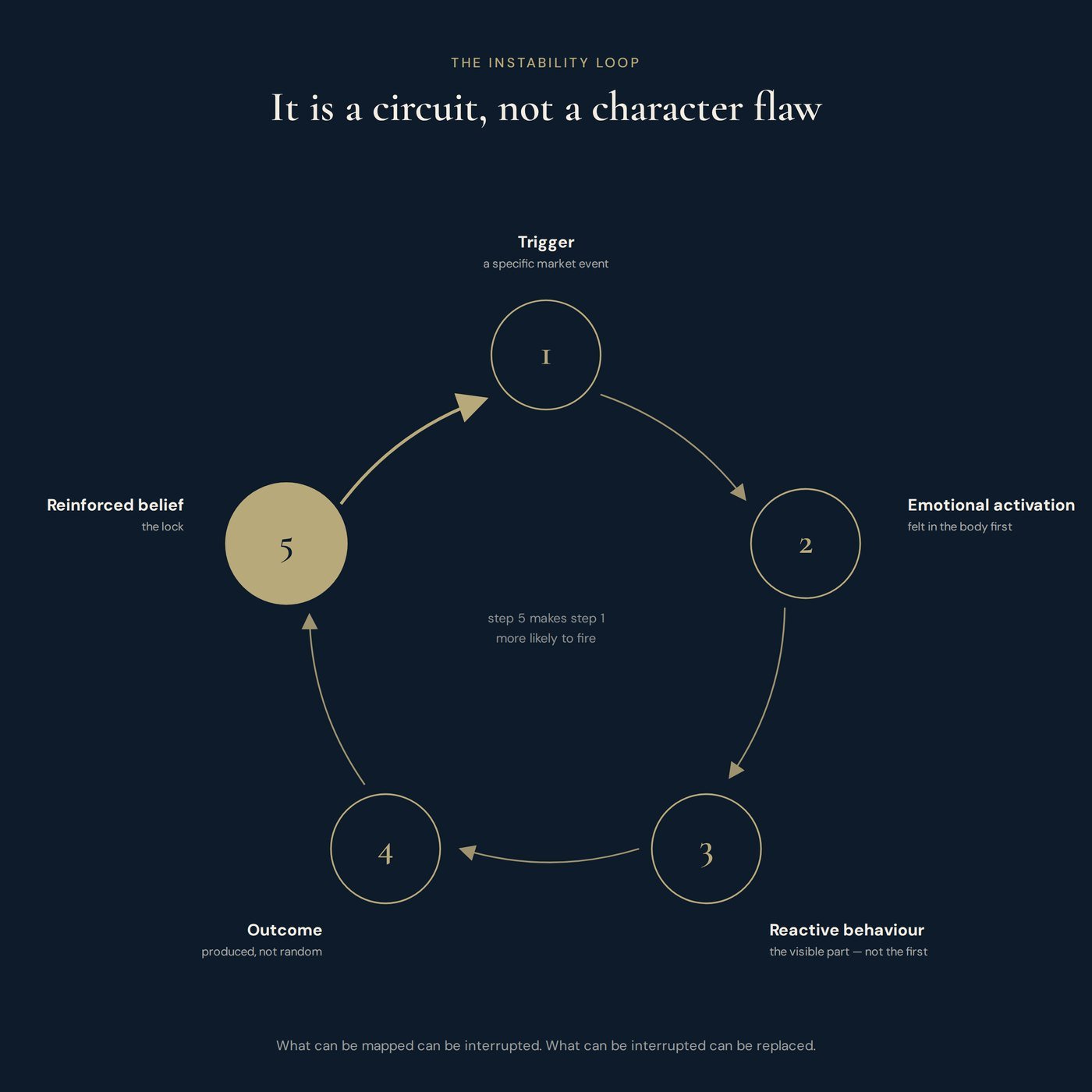
It is not a character flaw. Every trader has one. The problem is not that it exists — it is that it runs below the level where rules operate.
The five steps
1 · Trigger — A specific market event
A loss, a missed entry, a gap open, a fast move against the position. Not all market events fire the loop. Yours has specific ones, and finding them is the first piece of work.
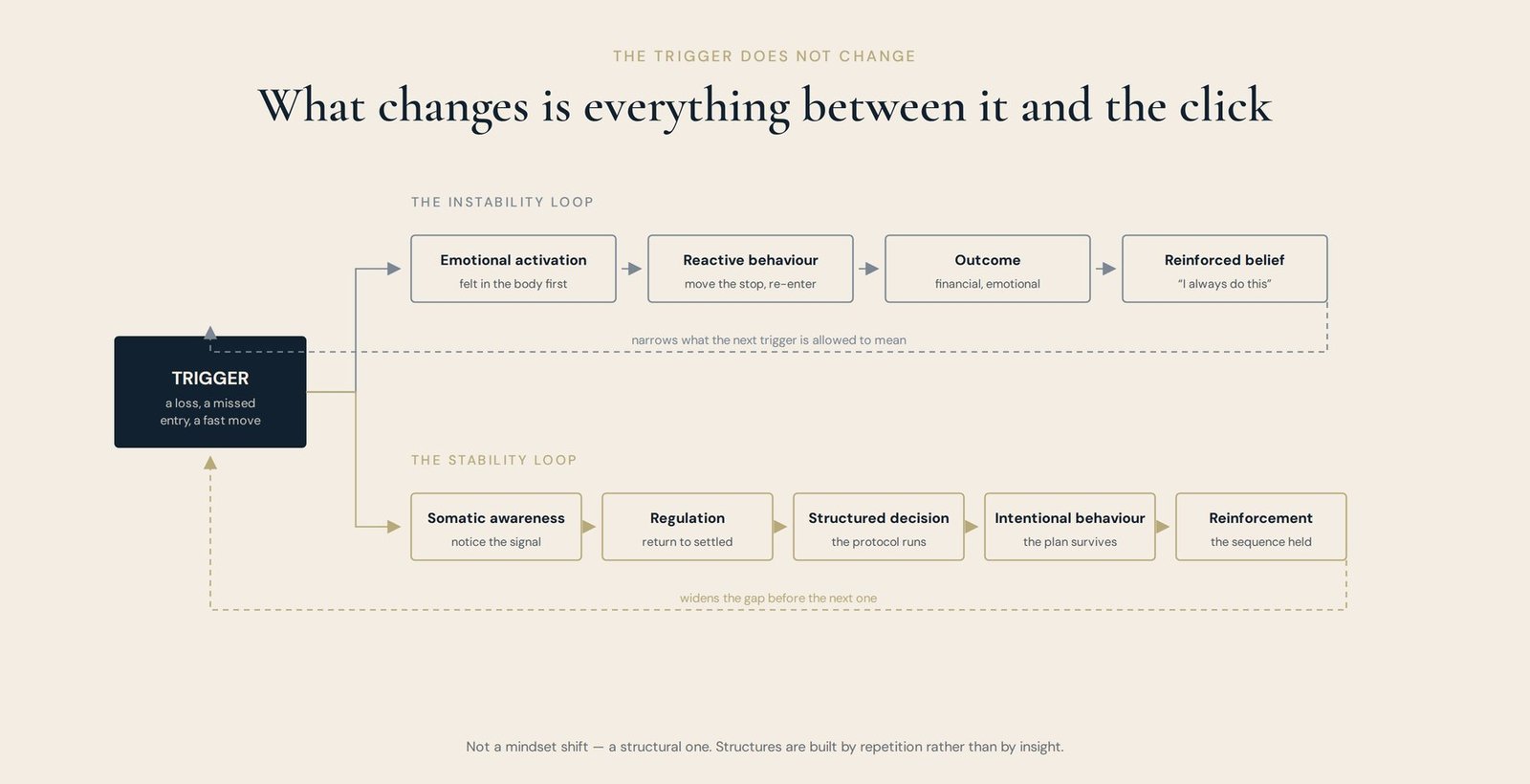
In the stability loop this becomes Trigger — unchanged — the trigger is not the part that moves.
2 · Emotional activation — The state the trigger produces
Fear, urgency, shame, excitement, numbness. It is felt in the body before it is named in the mind. It is not a choice. It is a response.
In the stability loop this becomes Somatic awareness — the same signal, noticed while it is still a signal.
3 · Reactive behaviour — What the activated state drives
Moving a stop. Revenge trading. Exiting too early. Freezing at the entry. This is the visible part of the loop. It is also not the first part, which is why working on it directly tends to fail.
In the stability loop this becomes Regulation, then a structured decision — two steps inserted where there were none.
4 · Outcome — The result the behaviour produced
Financial, emotional, or relational. The outcome is not random. It was produced by the behaviour the loop drove, and the loop already knew what to expect.
In the stability loop this becomes Intentional behaviour — the plan survives contact with the trigger.
5 · Reinforced belief — The lock
“I always do this.” “I cannot trust myself.” “The market is against me.” This belief narrows the window through which the next trigger is seen, which makes the loop more likely to fire again, harder and faster. Then it repeats.
In the stability loop this becomes Process reinforcement — what gets confirmed is that the sequence held.
What replaces it
The stability loop starts at the same place. A trigger still fires, and it still has to be answered by an action. What changes is the architecture in between: somatic awareness, regulation, a structured decision, an intentional behaviour, and a reinforcement that confirms the sequence held rather than confirming the belief.
Why rules do not reach it
Your rules live in the prefrontal cortex — planning, self-regulation, following through. The loop fires from older, faster circuitry that evolved to answer threat long before trading existed. When it fires it does not ask permission. Your rules arrive afterwards, as regret, as analysis, or as the question you keep asking yourself: why did I do that again?
This is not an argument against having rules. It is an argument that rules are the wrong place to intervene, because by the time a rule can be consulted the behaviour has already happened. The intervention that works is structural — steps built into the interval between trigger and action, rehearsed until the sequence runs without being chosen. That takes repetition rather than insight, which is why it takes weeks rather than an afternoon.
Where the four surface patterns fit
The structure above is the same for everyone. What differs is how it presents: how narrow the gap between trigger and action is, which step is most visible, and where the loop is easiest to interrupt. The pattern quiz identifies which behaviour is running your trading under pressure, and the free sample it sends maps that result onto four surface descriptions — reactive, controlled, avoidant and impulsive.
Sources and related reading
The mechanisms underneath this page: the somatic marker hypothesis, which is why step two is felt before it is named, and self-serving bias, which is why an account written after the close records an explanation rather than a state.
Related on this site: what trading psychology actually is, why more discipline is the wrong prescription, and a protocol for a journal that changes behaviour.
These are descriptions of a behavioural mechanism. They are not financial advice, not a trading strategy, and not psychological treatment.
The full 21-day protocol built on this structure is The Stability System — a Protocol book you read and a Response Journal you write in, ending with your own written sequence for the moment your pattern fires.
It is opening to a founding cohort of twenty traders, free, in exchange for four short check-ins on what actually changes. Places are chosen from a short application: apply for a founding place.